
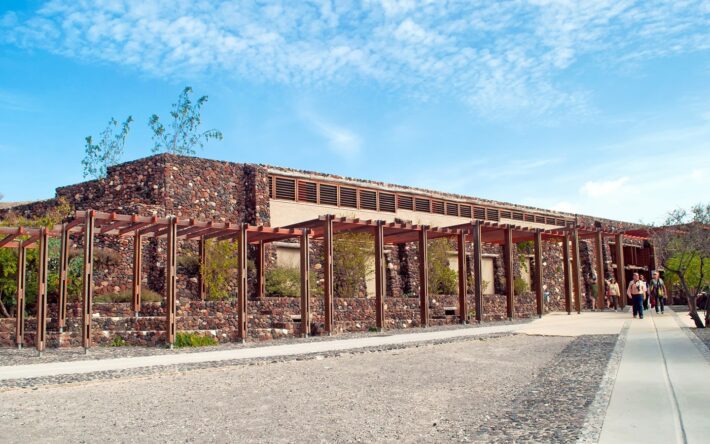
The southernmost tip of Santorini is a place where postcard-perfect cliffs and blue-domed churches give way to an archaeological site encased in a giant bioclimatic shelter. Most visitors to Santorini are content to while away their time admiring the vistas and lounging on the volcanic sand beaches of Perissa but have no idea that an entire ancient city is being unearthed right before their eyes.
Not Just Another Minoan Pompeii
Traveller guides tend to give historic sites a label to hang onto, frequently describing Akrotiri as the Greek Pompeii, although this comparison misses a great deal. While Akrotiri certainly predates Pompeii by roughly a millennium it’s also missing the despondency of the finished excavations. Walk the hanging walkways on the excavation site and there isn’t a single skeleton to be seen among the wreckage. The wise residents of the Aegean city clearly sensed the ground shuddering from the precursor earthquakes to the great eruption and heeded the warning cries of fellow islanders who’d felt the rumblings of the Thera volcano.
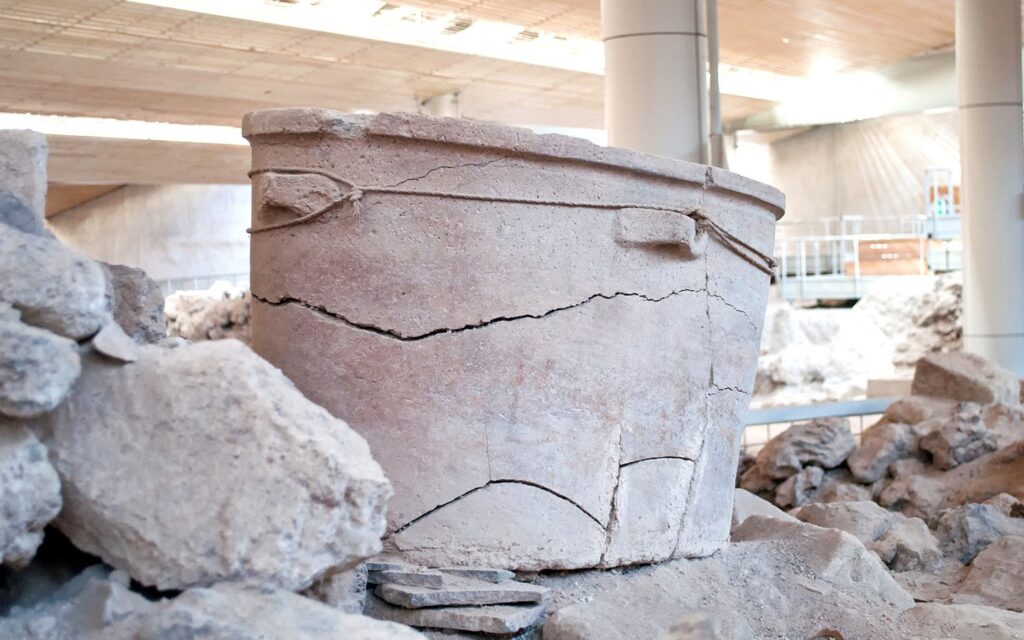
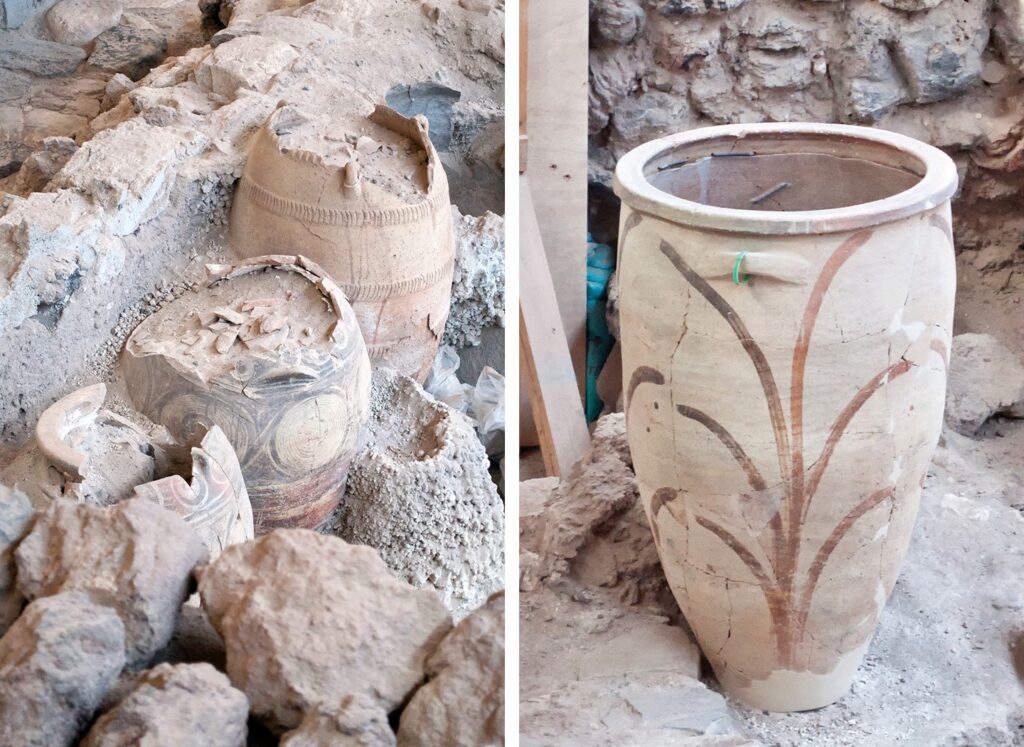
They hastily loaded their most prized lightweight possessions onto boats and departed the island, leaving a great amphorae of olive oil and wine, stone tables, and even beautiful wall paintings behind, enabling modern-day explorers to see an orderly evacuation rather than a mass grave.
The Bronze Age Metropolis That Set Urban Planning Standards
Before there were any official planning departments to dictate the matter, the clever creators of Akrotiri were constructing a city that could rival any modern coastal suburb. Excavated layers show that occupation of the site began as early as 4500 BC, with the gradual evolution of a small Neolithic village into a thriving trading port. Thanks to its location between the Greek mainland and Crete and North Africa, the city saw great revenues from the export of local volcanic minerals, stunning pottery, the fragrant saffron from the region’s crocuses, and a cornucopia of produce. The prosperity enabled the construction of some remarkable structures.
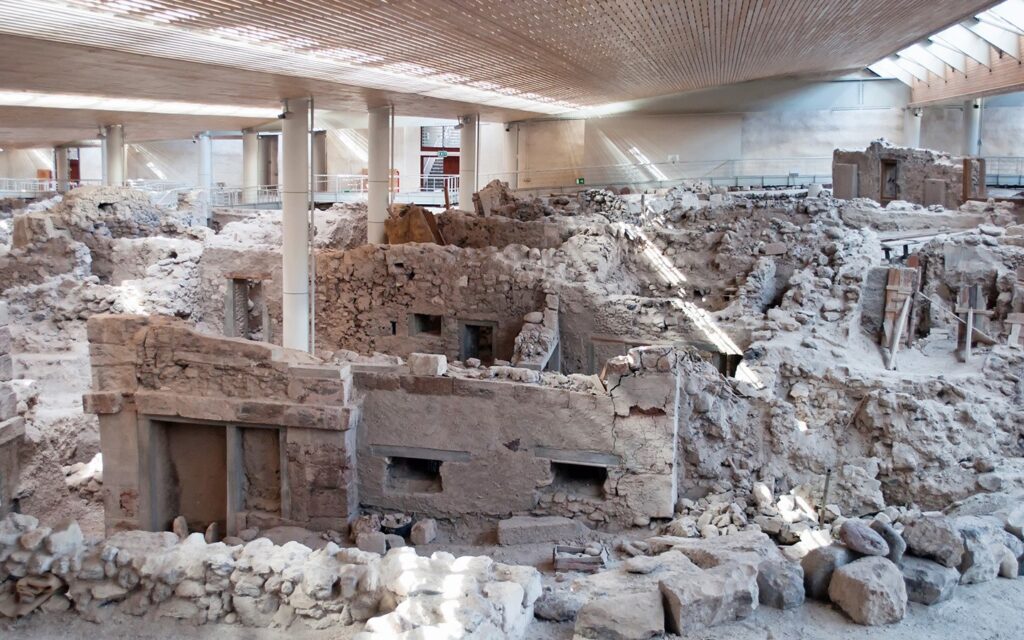
Citizens lived in impressively high buildings of two and three levels that had a unique composite framing of wooden beams within the stone and mud-brick walls, creating a flexible framework for seismic shocks. Take a closer inspection of the ruins and you’ll see the advanced drainage system, with channels running beneath the paved streets, removing waste from the complex and separating it from other household refuse in stunning examples of Bronze Age sanitation engineering.
Some of the internal chambers even had rudimentary examples of what we’re used to regarding private bathrooms, showing that modern comforts have been a long-sought desire by humans throughout the ages.
Art and the Vibrant World of the Frescoes
Perhaps the most surprising feature of Akrotiri is the riot of color in the frescoes which decorate many of the buildings’ upper chambers. While most ancient remains present a monochrome view of sun-bleached stone, the Aegean symbolically bursts with blue, ochre, red, and green. The reason behind this preservation of the delicate paintings is the thick layer of volcanic ash which smothered the city and prevented any water penetration.
While most of these beautiful works of art are now safely displayed in the Museum of Prehistoric Thera in Fira the excavated ruins still provide stunning examples of the creative talent of the Aegean isles. The frescoes depict a harmonious and nature-loving people, with images of boys clutching fish caught from the sea, acrobatic antelopes leaping over rocky landscapes, and women harvesting the prized saffron crocuses. One particularly impressive chamber known as the House of the West depicts an entire miniature frieze of a fleet of ships sailing between the Aegean’s trading ports, celebrating a golden age of maritime enterprise.
These images of the frescoes dispel the image of the grim and warlike ancient inhabitant. The people of Akrotiri decorated their living spaces with images of indigenous plants rather than bloodthirsty gods, fine athletic young men instead of savage warriors, and strange monkeys interspersed with the day-to-day tasks of the domestic sphere. It’s an impressive insight into a sophisticated society that held beauty and culture above all else.
The Cataclysm That Changed the Aegean Forever
Despite all of the attractions of the ruins of Akrotiri, this is ultimately a story of a great loss. Somewhere around 1700 BC or so, the erupting volcano of Thera erupted with cataclysmic force, sending hundreds of thousands of tons of magma and rock into the atmosphere and creating a huge water-filled caldera at the center of the island, which is present day Santorini.
The powerful quake and following tsunamis devastated the Minoan civilization throughout the southern Aegean, changing the climate and causing untold damage. It has even been said by historians and mythologists that this great disaster was the inspiration for Plato’s tale of Atlantis, lost to the sea many centuries later. What is certain is that the great changes to the island were enough to bury the ancient city under centuries of sterile ash, which eventually allowed it to be discovered once again in 1967.
Seeing Akrotiri Today: A Few Notes to Remember
Exploring the excavated city requires a different approach to the typical sightseeing tour of Santorini. To obtain the most enjoyment from your visit to the ruins you should take note of the following tips.
The excavated city lies beneath a bioclimatic roof designed to keep the Cycladic heat from ruining your exploration of the site. The wooden walkways run alongside many of the excavated streets, enabling you to see the ancient workshops, storage chambers full of giant pithoi jars, and doors with stone hinges.
Practical Visiting Tips
First Light or Last Light: Aim for early mornings or late afternoons to visit the site. If you’re not planning on visiting the whole of Santorini, the tour buses tend to arrive mid-day and can block your view of the walkways from the best vantage points. Avoid the peak hours in the blistering Cycladic sun.
Fira: Be sure to visit the Museum of Prehistoric Thera in Fira town. While the ruins of Akrotiri can show you the bones of the city that once was, the museum has the beating heart, with the actual frescoes, gold ibex sculptures, and intricate jewelry excavated from the site.
Hire a Guide: Simply wandering the ruins can seem like staring at a jumble of brown rocks, unless you know what to look for. Hiring an archaeologist guide at the site entrance can turn a quiet walk among the stones into an amazing adventure full of ancient history and human interest.
Landmarks: As the ruins are on the southern coast of Santorini, it’s an easy excursion to combine with a visit to the local Akrotiri lighthouse for sunset, or the popular Red Beach cliffs (although always check local safety conditions for the coastal footpath).
The Timeless Allure of Thera
Akrotiri is a humbling experience for the modern-day traveler who is looking to connect with the past. Standing on the wooden walkways above a paved square from the Bronze Age, you can’t help but think that all too often human worries have been the same for the four-thousand years spanning our time on Earth. The people who walked the stone streets fretted about trade and barter, decorated their rooms with the images of the natural beauty of the world around them, and built strong homes for their children to live in, unaware of the sleeping mountain which would bury their beloved city – and gift it with undying fame.
As you exit the ruined city into the glorious blue waters of the caldera, look out over the vast horizon. Below the still surface of the water lies the ghost of a giant, whose long life is a testament to the strength of humankind, enabling us to marvel at our ancient past, and wonder at what it means to be human.

Panagiotis Inglesis is the co-owner and General manager of Athina Luxury Suites, along with his wife Mrs.Artemis Argyrou. Together they had a vision to create one of the best boutique hotels in Santorini and today they continue their vision…Athina Luxury Suites is considered one of the top hotels on the island.